jazz Music – issue #10
Jazz is a music genre that originated in the African-American communities of New Orleans. Since the 1920s Jazz Age, it has been a major form of musical expression in traditional and popular music. It was developed partially from ragtime and blues. often characterized by syncopated rhythms and polyphonic ensemble playing. incorporating varying degrees of improvisation, often deliberate deviations of pitch, and the use of original timbres. As jazz spread around the world, it drew indigenous musical cultures, which gave rise to different styles. In the 1930s, arranged dance-oriented swing big bands was the prominent styles. Bebop emerged in the 1940s, representing a shift from danceable popular music. Now a more challenging music emerged which was played at faster tempos and used more chord-based improvisation. Cool jazz developed near the end of the 1940s, introducing calmer, smoother sounds and long, linear melodic lines. Free jazz is a style of avant-garde jazz . This experimental style of jazz improvisation developed in the late 1950s and early 1960s. Jazz fusion appeared in the late 1960s and early 1970s. a Fusion combining jazz improvisation with rock music’s rhythms, electric instruments, and highly amplified stage sound.
In the early 1980s, a commercial form of jazz fusion called smooth jazz became successful, garnering significant radio airplay. For almost all of its history it has employed both creative approaches in varying degrees and endless permutations. despite the all these diverse styles, jazz is distinguishable as something separate from all other forms of musical expression. Especially from classical music. The jazz performer is primarily or wholly a creative, improvising composer. On the other hand in classical music the performer typically expresses and interprets someone else’s composition.
Join the Conversation!!!
we will Feature Up to 4 Albums from Artists representative of a range of the Many sub-genres. We Hope to encourage Listeners of all tastes and passions. So Get your Headphones on and Consider discussing the musical Offering and sharing your views with like-minded peers.
In Issue #10, we feature dizzy gillespie
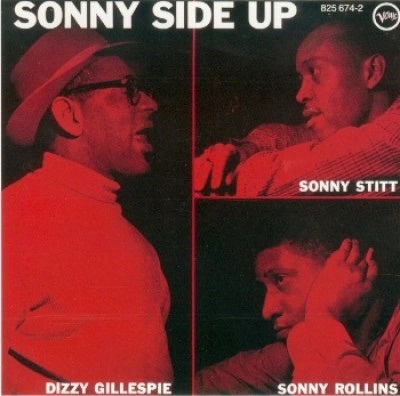
Sonny Side Up is a legendary 1959 jazz album led by master trumpeterDizzy Gillespie, featuring a historic “tenor battle” between saxophone titans Sonny Rollins and Sonny Stitt. Recorded in New York City on 19 December 1957, the session was produced by Norman Granz for his newly launched label, Verve Records. It is widely celebrated as one of the most explosive, competitive, and exhilarating jam sessions in bebop and hard bop history. Jazz lore indicates that producer Norman Granz and Dizzy Gillespie playfully stoked a competitive fire between the two saxophonists before they entered the studio. By making phone calls suggesting the other “Sonny” was going to outplay them, they engineered a fierce cutting contest. On the record, Stitt attacks with flawless, aggressive bebop machinery, while Rollins responds with massive tone, thematic structural pacing, and rhythmic complexity.
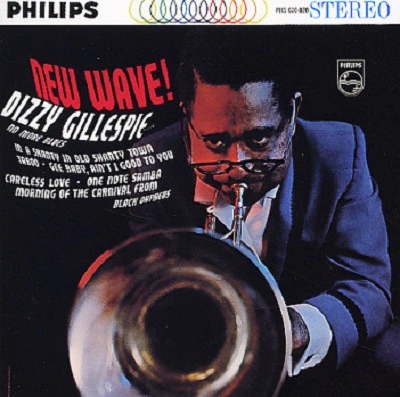
“New Wave” translates directly to “Bossa Nova” (the literal Portuguese meaning of bossa nova is “new trend” or “new wave”), positioning Gillespie as a crucial, early American pioneer of the Brazilian jazz movement. Produced by the iconic Quincy Jones, the album captures Gillespie at the absolute peak of his creative powers. He seamlessly blends his foundational bebop style with the cool, syncopated rhythms of Brazilian Samba. The tracks are a mix of live performances from the 1962 Monterey Jazz Festival and studio sessions.
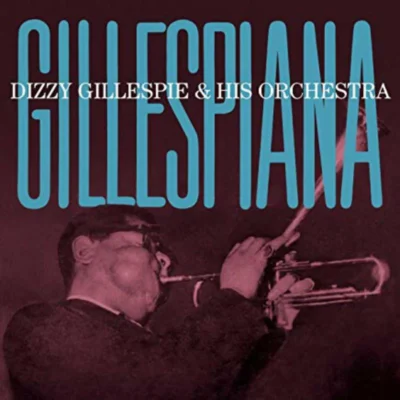
Gillespiana is a landmark 1960 jazz album featuring a five-movement suite composed and arranged by Argentine pianist Lalo Schifrin. Released on the Verve label, the project represents a spectacular blend of bebop and third-stream orchestration, heavily layered with Afro-Cuban and pan-American rhythms. The album consists of five distinct movements, each spotlighting a different facet of Gillespie’s musical heritage and the band’s virtuosity: Prelude: A medium-fast, boppish introductory movement that sets high energy levels. Blues: A deeper, slower movement showcasing expressive soloing and harmonies. Panamericana: A section focused on South American folk influences and rhythmic syncopation. Africana: An exploration of traditional African rhythms and call-and-response patterns. Toccata: A fiery, rhythmically complex closing movement built around cascading piano lines and frantic horn playing.
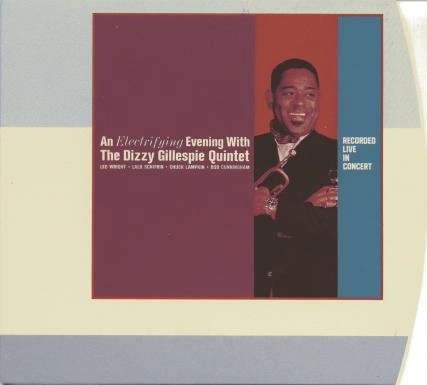
An Electrifying Evening with the Dizzy Gillespie Quintet is a highly acclaimed 1961 live album It stands out as one of the best live sets of his career. The album was recorded on 9 February 1961 during a concert at the Museum of Modern Art (MoMA) in New York City. Released under Verve Records, it captures a stripped-down, loose, and incredibly creative performance. Critics and fans regularly celebrate the album for its pristine recording quality and peak-form solos.
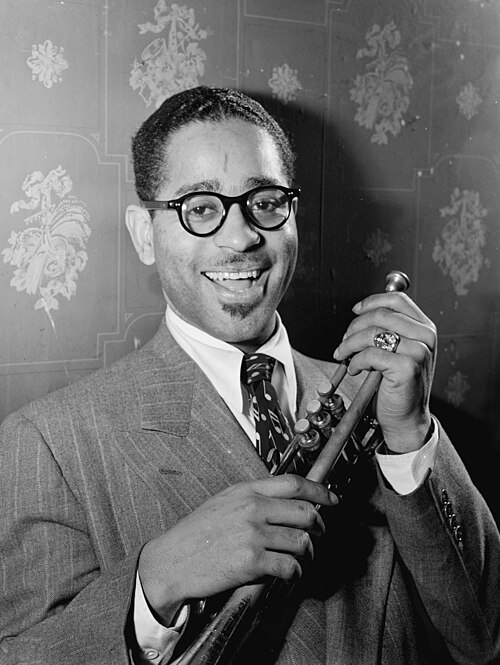
“Dizzy” Gillespie, along with Charlie Parker, ushered in the era of Bebop in the American jazz tradition. Renowned for his complex harmonic improvisations and unmatched trumpet virtuosity, he became an enduring cultural icon easily recognized by his trademark puffed-up cheeks and custom 45-degree upturned trumpet b.
Dizzy Gillespie was born in Cheraw, South Carolina, the youngest of nine children of Lottie and James Gillespie. His father was a local bandleader, so instruments were made available to the children. James died when Dizzy was only ten years old. Gillespie started to play the piano at age four and by the time he was 12, he taught himself how to play the trombone and the trumpet. From the night Gillespie heard his idol, Roy Eldridge, on the radio, he dreamed of becoming a jazz musician. He won a music scholarship to the Laurinburg Institute in North Carolina, which he attended for two years before accompanying his family when they moved to Philadelphia in 1935. Gillespie’s first professional job was with the Frank Fairfax Orchestra in 1935, after which he joined the orchestras of Edgar Hayes and later Teddy Hill, replacing Frankie Newton as second trumpet in May 1937. Teddy Hill’s band was where Gillespie made his first recording, “King Porter Stomp”. In August 1937 while gigging with Hayes in Washington D.C., Gillespie met a young dancer named Lorraine Willis who worked a Baltimore–Philadelphia–New York City circuit which included the Apollo Theater. Willis was not immediately friendly, but Gillespie was attracted anyway. The two married on May 9, 1940. Gillespie stayed with Teddy Hill’s band for a year, then left and freelanced with other bands. In 1939, with the help of Willis, Gillespie joined Cab Calloway’s orchestra. He recorded one of his earliest compositions, “Pickin’ the Cabbage”, with Calloway in 1940. After an altercation between the two, Calloway fired Gillespie in late 1941. Calloway disapproved of Gillespie’s mischievous humour and his adventuresome approach to soloing. Gillespie stabbed Calloway in the leg with a knife; Calloway had minor cuts on the thigh and wrist. After the two were separated, Calloway fired Gillespie. A few days later, Gillespie tried to apologize to Calloway, but he was dismissed.
During his time in Calloway’s band, Gillespie started writing big band arrangements for Woody Herman, Jimmy Dorsey, and others. He then freelanced with a few bands, most notably Ella Fitzgerald’s orchestra, composed of members of Chick Webb’s band.Gillespie did not serve in World War II. At his Selective Service interview, he was classified as a person not qualified for military service due to physical, mental, or psychological unfitness. In 1943, he joined the Earl Hines band. Gillespie later joined the big band of Hines’s long-time collaborator Billy Eckstine, and it was as a member of Eckstine’s band that he was reunited with fellow band member Charlie Parker. In 1944, Gillespie left Eckstine’s band because he wanted to play with a small combo. Gillespie compositions like “Groovin’ High”, “Woody ‘n’ You”, and “Salt Peanuts” sounded radically different, harmonically and rhythmically, from the swing popular at the time. “A Night in Tunisia”, written in 1942 while Dizzy was with Earl Hines’s band, is noted for its syncopated bass line. Bebop was not considered revolutionary at first, but was seen as an outgrowth of swing. In December 1945, Dizzy Gillespie and his Bebop Six, which included Charlie Parker, started an extended gig at Billy Berg’s club in Los Angeles. Reception was mixed and the band broke up. He started to organize big bands in late 1945.
In February 1946, Gillespie signed a contract with Bluebird, gaining the distribution power of RCA for his music. In the late 1940s, Gillespie was involved in the movement called Afro-Cuban music, bringing Afro-Latin American music and elements to greater prominence in jazz and even pop music. In 1951, Gillespie founded his record label, Dee Gee Records; it closed in 1953. At a party in 1953 where his trumpet’s bell was accidentally bent upward. However, he liked the sound so much he had a special trumpet made with a 45-degree raised bell, a customization that would become his trademark. In 1956 Gillespie organized a band to go on a State Department tour of the Middle East which was well-received internationally and earned him the nickname “the Ambassador of Jazz”. During this time, he also continued to lead a big band that performed throughout the United States and featured musicians including Pee Wee Moore and others. This band recorded a live album at the 1957 Newport jazz festival that featured Mary Lou Williams as a guest artist on piano. Although his most innovative period was over by the end of the 1950s, Gillespie continued to perform at the highest level. During the 1970s he made several big band, small-group, and duet recordings (with such players as Oscar Peterson and Count Basie) that rank among his best work. As an active musical ambassador, Gillespie led several overseas tours sponsored by the U.S. State Department and travelled the world extensively, sharing his knowledge with younger players. During his last few years, he was the leader of the United Nations Orchestra, which featured such Gillespie protégés as Paquito D’Rivera and Arturo Sandoval. A longtime resident of Englewood, New Jersey, Gillespie died of pancreatic cancer on January 6, 1993, at the age of 75. His funeral was held on January 12 at St. Peter’s Lutheran Church, with Roberta Flack singing Amazing Grace. His grave in Flushing Cemetery, Queens is unmarked.
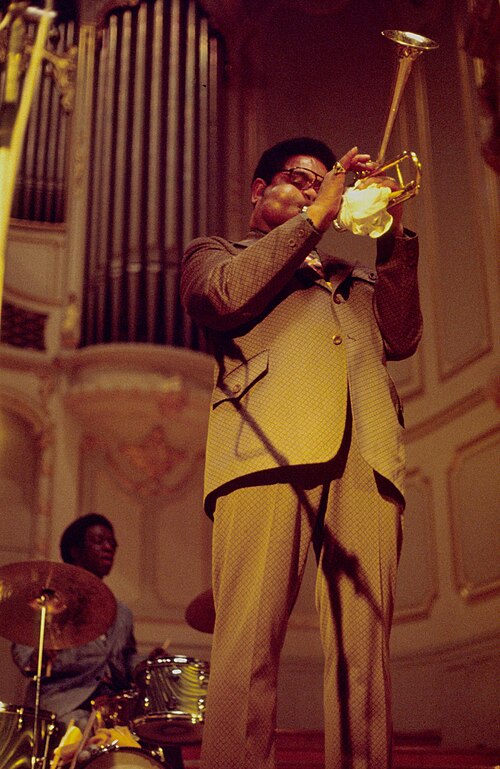
The Birth of Bebop: Moving away from standard 1930s swing music, Gillespie introduced blazing fast tempos, intricate chord changes, and sophisticated rhythmic variations.
Afro-Cuban Jazz Pioneer: Collaborating with Cuban artist Mario Bauzá, Gillespie was among the first to fuse Afro-Latin rhythms into mainstream American jazz, creating timeless masterpieces.
Sound quality is important and the better online Streaming services will offer superior sound quality. As always, We do encourage you to purchase Favoured albums from good online or High street record stores. Dizzy Gillespie's Labels - sonny Side up, an electrifying evening with the Dizzy Gillespie quintet and Gillespiana - Verve Records ; New Wave - Philips records
Artists in upcoming issues: Keith Jarrett, jaco pastorius.....Keep Listening!! JOIN THE CONVERSATION...jazz Music
“Comments are most welcome and appreciated”